Is this tree useful?
May 2019
I was sitting in the shade of a great old tree, watching children run about. Sitting there, I thought of a documentary I had seen not long before about the industrial designer Dieter Rams, an old man now.
Why do we keep calling him back? What does he mean to a time like ours?
He asks:
Why does the name — the brand — have to sit so large across the front of a thing?
Why design a car to be fast, rather than to be better?
Why should a design change again just to serve the marketing?
I can answer him. I am not sure my answers are right. The world fills up with more and more useful things. Even so, useful doesn't mean better.
I look up at the branches and leaves over my bench. This tree didn't grow for my use. It grew for itself, put out its branches, opened its leaves. I only borrowed the place for a while. Until I sat down under it, the shade it cast was of no use to anyone.
And then everything we throw away. Beside my bench is all that's left of the neighbourhood festival — thrown out the moment the fun ended, because it had stopped being useful.
The useless may only be a use nobody has found yet, or one we have forgotten. And the useful may be a uselessness we haven't understood yet.
I say this carefully. Still — couldn't there be more of the kind of uselessness you borrow for a while, the way I borrowed this shade? Couldn't we borrow a thing for a while, and let that be what keeps things in balance?
In a world shouting about what is useful, I am trying to listen to what isn't.
The circle of wholeness
July 2024
My eyes are going. What I see clearly and what I don't have traded places. When your seeing changes, your thinking changes with it.
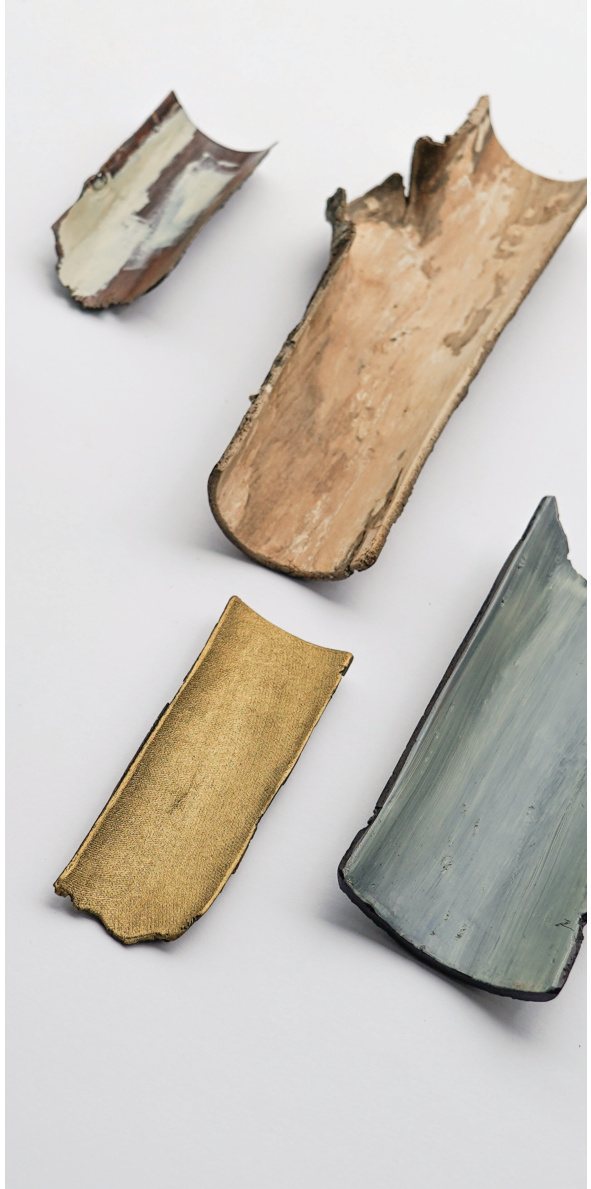
The bookmark stand in the photograph came from a tree left lying at a building site last winter, cut down and abandoned. Over the turning seasons the wood gave up the water it had been holding, and it split. Split wood gets thrown out. It is classified as industrial waste. It has no use.
Before I was a craftsman I worked with a great many factories and research labs, here and abroad. Modern technology is a set of methods for keeping a material 'whole'. To stay inside the circle of wholeness we spend technique, and a great deal of energy, keeping wood from splitting. We are delaying, as long as we can, time's arrival at its destination.*
The higher our technical achievement, the narrower that circle of wholeness has grown. Yes — this is the thing we call 'sustainability'.
A craftsman is someone who loves the material. I want to bend our trust in 'wholeness'. I want to turn the noun 'wholeness' into the verb 'to be whole'.
I lay lacquer over the split. Through the lacquer you can still see the marks the cracks left — the traces of the tree breathing out. It looks as though it is alive and going on breathing.
Looking up, I find I am reaching to the right for the feel of the hand and to the left for art. I wonder whether there isn't another road for craft.
The future is doing its best to become the past.* I would like to carve the present out of that block called the future, the one with no fixed shape.*
The beauty every day makes — crossing between the useless and the useful.
*Some of these sentences are adapted from Hernan Diaz's novel Trust.
It doesn't have to become anything
October 2025
A block of oak I have kept a long time. It is beautiful without having to become anything. It comes from where a branch forks away, so the grain is dense and it doesn't carve easily. I am making it into a tea scoop, the kind that moves the leaves. Most of it is left as it was — rough, and full of points.
I ask where nature ends and craft begins.
I ask where craft ends and technique begins.
I ask where AI ends and 'I' begin.
Technique is finding something and taming it. I wanted to ask about those borders, though in truth they matter less than I thought. People are not going to stop widening what they call 'I'.
What I do know is that the block still looks alive to me, and that we seem to have become friends, to have spent the day playing. That is all of it, and it is enough. Tidying the bench afterwards, I catch myself hoping to be 'plain and dry'.
*Strictly speaking this is a story from 'the shop for straying' rather than 'the shop for everyday tools'.